
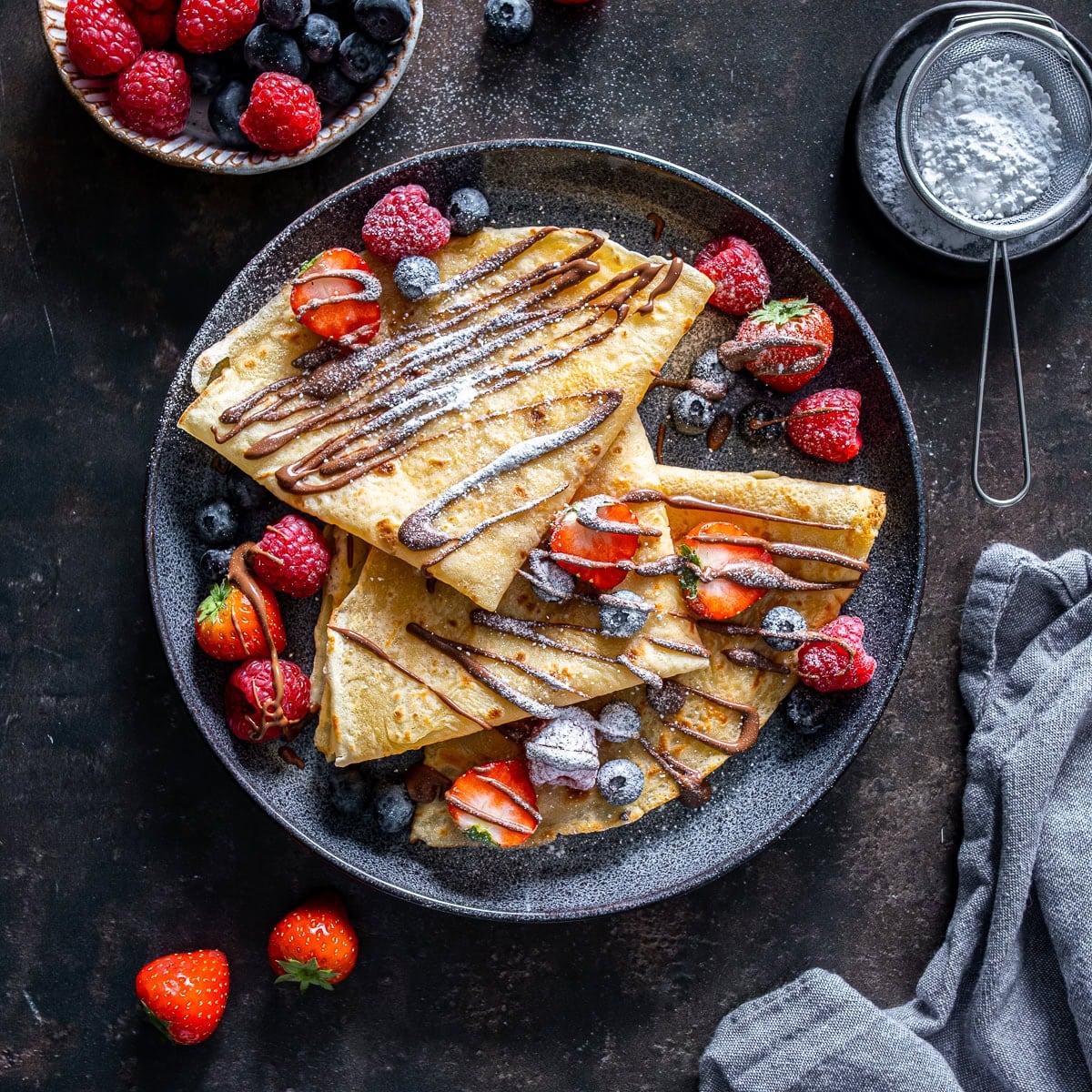
Crêpes have a reputation for being difficult to make – but not with this Easy Peasy Crêpes recipe! Make perfect crêpes every time with my tricks and tips. Perfect for pancake day… or any time you fancy French-style pancakes.
This blog post contains affiliate links. This means if you click on a link and go on to buy the product I recommend, I will get a small commission, but you will not be charged a penny more – thanks in advance!
Crêpes – made easy!
I adore pancakes of all types, but I have a special place in my heart for crêpes (AKA French Pancakes). I used to live in Paris and I remember very fondly the many, many trips to crêperies I made when I was there.
However, making them at home is a different story. Crêpes have a reputation for being difficult to make. And I won’t lie, I have had my fair share of crêpe-related disasters in the past! But I have persevered and over time developed this Easy Peasy Crêpe recipe that’s pretty much foolproof!
These delicious French pancakes are perfect for pancake day (AKA Shrove Tuesday), brunch, dessert… or any time you fancy French-style pancakes.

How to make homemade crêpes – the easy peasy way!
My recipe for crêpes is surprisingly easy and practically foolproof!
All you need to do is make the simple 5 ingredient batter and leave it to rest for 30 minutes. Then, heat a little oil in a crêpe pan (or a regular frying pan). Next, pour 1 ladleful of pancake batter into the pan and swirl. Then, place the frying pan back over the heat and allow the pancake to cook for roughly 15 seconds.
When the pancake is cooked nicely on the bottom, either toss the pancake or use spatula to turn the pancake over. Cook the pancake for about 10 seconds on the second side, then slide out onto a plate. Repeat until you have turned all the batter into pancakes!

5 Tips for making crêpes
The biggest tip I can give you for making crêpes is to use my recipe!
I’ve worked hard on this recipe to come up with one that is practically foolproof. (Not all crêpe recipes are – and some seem to be created to make it extra hard!)
But here are some other useful crepe-making tips…
1. Use a good non-stick pan
Honestly, a bad pan is probably the biggest reason for pancake-related disasters! If you possibly can, I recommend you get a good crêpe pan. This is the one I use: Tefal Non-Stick 25cm Crêpe Pan* A proper crêpe pan is designed for the job and will make it that little bit easier. But a regular frying pan will work almost as well, so long as it’s a good non-stick one. If it’s cheap or old, your pancakes will most likely stick and you’ll end up with a right old mess!
2. Use a crêpe spatula
My second tip is to use a long thin spatula that is designed to lift crêpes. You can of course improvise with a fish slice, but a crêpe spatula will make your life that much easier! Go for a silicone one that won’t scratch your non-stick pan. This is the one I use: Tefal Silicone Crêpe Spatula*
3. Leave the batter to rest
To be honest, I am a little hazy about the science. But there is no denying, you’ll make better pancakes if you leave the batter to rest for 30 minutes before frying.
4. Cook on a medium-high heat
The first time you make these, you might need to experiment a little to figure out the perfect heat on your hob, but once you’ve done it once, you’ll know! You are looking for a heat that cooks the batter in about 15 seconds on each side.
5. Use a small amount of oil for frying
Don’t pour in lots of oil every time you fry – it makes for very greasy pancakes! But equally so, you do need a little oil each time or they are likely to stick and not cook nicely. You can use butter if you prefer, but I find oil much easier to work with.

How to keep crêpes warm while you cook them?
If you want everyone to be able to eat the crêpes at the same time, you’ll need to keep the cooked pancakes warm while you cook the rest. Fortunately this is very easy.
All you need to do is turn your oven on to 120C (100C fan / gas mark ½ / 250F) and put an ovenproof plate* in the oven. Every time you finish cooking a crepe, simply grab the plate out of the oven (with oven gloves, obviously!) and slide the cooked pancake onto the plate. Eventually you’ll have a nice big stack of warm pancakes ready to eat, all together.
(So much nicer than being stuck in the kitchen on your own while your family are tucking into pancakes without you!)

What toppings should you serve with Crêpes?
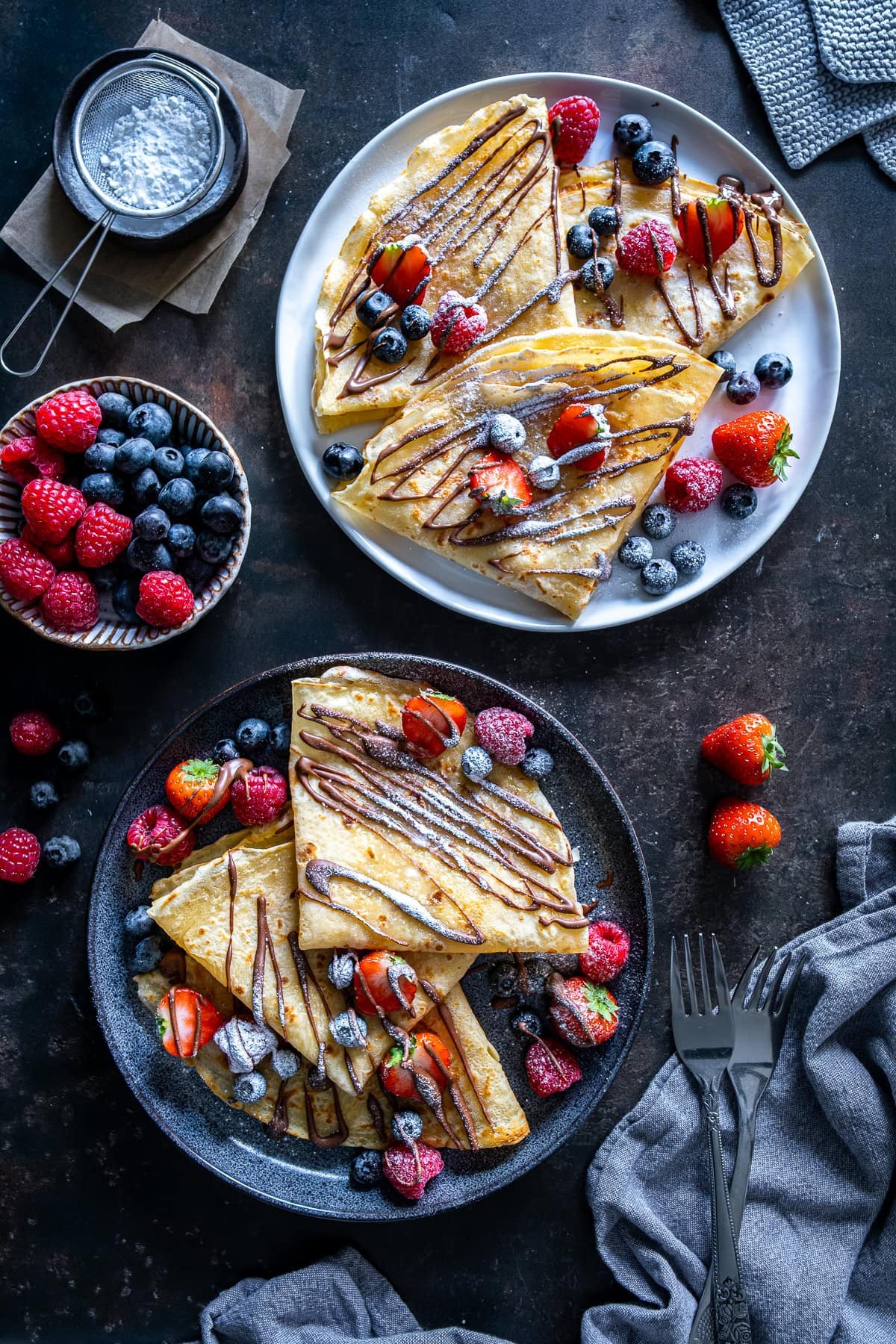
There are so many good options for crêpe toppings! One of my favourites is fresh berries and Nutella, as shown in the photos, but you can also go for:
- Lemon and sugar
- Maple syrup
- Sliced banana
- Stewed apples / apple sauce
- Jam
- Ice cream
- Chopped nuts
- Hundreds and thousands
- Fruit compote
- Whipped cream
- Chocolate sauce
- Nut butters
- Bacon
And, of course, you can mix and match many combinations of these toppings!
Love pancakes?
Then check out these delicious recipes:
- Traditional English Pancakes
- Easy Peasy American Pancakes
- Easy Scotch Pancakes (AKA Drop Scones)
- 3 Ingredient Banana, Oat, Egg Pancakes

Easy Peasy American Pancakes
Can you reheat cold crêpes?
Absolutely! Simply place the cold crêpes in a stack on an ovenproof plate or baking sheet and cover with foil. Place in a pre-heated oven, set to 180C (160C fan / gas mark 4 / 350F), and heat for 5-10 minutes until all the crêpes are piping hot. (Exact timings will depend on the number of crêpes in your stack.)

Can you freeze crêpes?
Yes you can! Pancakes freeze very well. Simply layer cooked and cooked crêpes with baking paper (to stop them sticking together). Then, place the crêpes in a freezer bag (or suitable sized freezer-proof container) and put in the freezer, where they will keep for up to 3 months.
Defrost for a few hours at room temperature. Reheat as above.

If you like this recipe…
…you might also like:
- Traditional English Pancakes
- Easy Peasy American Pancakes
- Easy Scotch Pancakes (AKA Drop Scones)
- 3 Ingredient Banana, Oat, Egg Pancakes

3 Ingredient Banana Oat Egg Pancakes
Easy Peasy Crêpes (French Pancakes)
Ingredients
- 250 g plain flour
- ¼ teaspoon salt
- 3 large eggs
- 500 ml semi-skimmed milk
- 2 tablespoons olive oil
- Oil for frying
- Toppings of your choice
Instructions
- Place the plain flour and salt in a mixing bowl and mix together thoroughly (to ensure the salt is evenly distributed).
- Measure out the milk in a measuring jug and add the 3 eggs and 2 tablespoons olive oil. Use a balloon whisk to mix the milk, eggs and oil together thoroughly.
- Pour the liquid into the flour slowly, whisking constantly to ensure the flour and liquid are well combined. You should end up with a smooth pancake batter that is roughly the consistency of single cream.
- Leave the batter to rest for 30 minutes. When you come back to it, whisk it again to ensure everything is still well combined. It should now be a little thicker – more like the consistency of double cream.
- Put 1 teaspoon of oil in a crêpe pan (or large frying pan - see Note 1) and place on a medium-high heat for 1 minute. Swirl the oil so it evenly coats the base of the frying pan and put the frying pan back on the heat.
- Pour 1 ladleful (See Note 2) of pancake batter into the crêpe pan and swirl so the batter coats the base of the pan, but doesn’t go up the sides.
- Place the frying pan back over the heat and allow the pancake to cook for roughly 15 seconds.
- Using a crêpe spatula (See Note 3) lift up one edge of the pancake to see if it is looking nicely cooked / a light golden brown.
- When the pancake is cooked nicely on the bottom, either toss the pancake or use the spatula to turn the pancake over. (The pancake should come away easily from the pan when cooked, but if it doesn’t, simply use your spatula to loosen it.)
- Cook the pancake for about 15 seconds on the second side.
- Again, you can use the spatula to lift up a corner and check it is nicely browned.
- When the pancake is cooked, tip it out onto a plate and place the frying pan back over the heat.
- Pour in about ½ a teaspoon of oil and swirl. Put the pan back on the heat and immediately pour in 1 ladleful of pancake batter into the frying pan and swirl.
- Repeat the above process to make the second pancake.
- Continue until you have used up all the pancake batter.
- Serve with toppings of your choice.
Notes
- A bad pan is probably the biggest reason for pancake-related disasters! If you possibly can, I recommend you get a good crêpe pan. This is the one I use: Tefal Non-Stick 25cm Crêpe Pan* A proper crêpe pan is designed for the job and will make it that little bit easier. But a regular frying pan will work almost as well, so long as it’s a good non-stick one. If it’s cheap or old, your pancakes will most likely stick and you’ll end up with a right old mess!
- I find a a soup ladle* is the best way to get just the right amount of batter into the frying pan each time. My soup ladle holds exactly 50ml (1¾ floz / ¼ cup) of batter, which is the perfect amount for 1 pancake. If you don’t have a soup ladle, you will need to find something else in your kitchen that will enable you to measure out 50ml each time, or judge it by eye. (If you have cup measures, you can use the ¼ cup.)
- I find a specially designed, long and thin crêpe spatula* to be the perfect tool to use to lift up the corner of each pancake to check if it’s done and also to flip the pancake if (like me!) your pancake tossing skills are not too good. But if you don’t have one, you can use a fish slice*.
- Suitable for freezing.
- Nutrition information is approximate and meant as a guideline only.
Pin Easy Peasy Crêpes for later

FREE 4 Week Easy Dinners Meal Plan
Have you got your hands on a copy of my meal plan yet? If not CLICK HERE to download a copy of my FREE 4 Week Easy Dinners Meal Plan today!
Don’t want to miss a thing?
Follow me on Twitter, Facebook and Instagram. Or why not subscribe to my blog and get delicious, stress free recipes straight to your inbox every week?
Disclosure
This blog post contains affiliate links, this means if you click on a link and go on to buy the product I recommend, I will get a small commission, but you will not be charged a penny more – thanks in advance!
Teresa Greenway says
I make these every week for the grandkids and everyone loves them. Thanks for an easy no faff recipe that works everytime 😊
Eb Gargano says
Aw – yay, that is so great to hear! Thank you for such a lovely review 😀